


Amblyopia treatment
To avoid the confusion this creates, it begins to ignore signals from the "weaker" eye.
The insidious nature of amblyopia is that it often goes unnoticed — the child sees well with one eye and does not complain of deteriorating vision. Parents may be unaware of the problem for a long time, until it is identified at a routine examination. This is why it is critically important to take your child for regular check-ups.
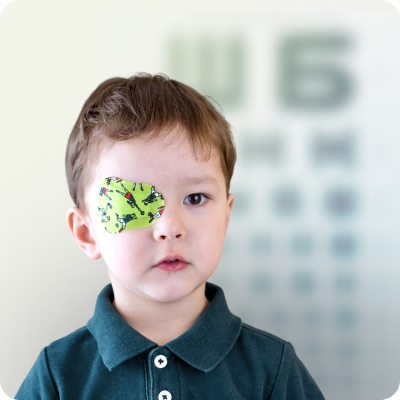
There is a view that amblyopia cannot be treated.
At Crystal Vision, however, we can free the child from this condition in 99% of cases. The technologies we employ allow not only vision to be restored — we can free the child from dependence on glasses entirely!
The most important thing is not to lose time — act at the first signs of a problem!
Types of amblyopia
Anisometropic amblyopia
Develops when there are significant differences between the optical systems of the right and left eyes. Treatment of this form of "lazy eye syndrome" involves selecting spectacle correction or soft contact lens correction alongside a programme of amblyopia treatment.
Deprivation (occlusion) amblyopia
Caused by congenital anomalies of the visual organs (cataract, corneal trauma, ptosis) that obstruct the passage of light rays onto the retina. In this case, treatment begins with the removal of the identified obstruction.
Disbinocular amblyopia
Develops in strabismus, when the brain processes information from only one eye in order to suppress diplopia. In strabismus, the coordinated function of both eyes is severely disrupted, and image transmission to the brain from one of the eyes (the more deviating one) simply ceases. The result is amblyopia, which further deteriorates vision.
Refractive amblyopia
Caused by refractive error in the eye and accompanied by blurred focus of objects in one or both eyes. Treatment of amblyopia in children in this case is carried out against a background of correct spectacle correction. In astigmatism, for example, refraction of light along the optical meridians is incorrect, resulting in two optical foci in the eye simultaneously, neither of which lies on the retina. This means that visual acuity in one meridian is significantly lower than in the other. Hysterical (psychogenic) amblyopia — arises in hysteria and is combined with disorders such as narrowing of the visual field, colour vision disturbance, and photophobia.
Diagnosis of amblyopia
A comprehensive examination is necessary to identify amblyopia and determine its causes. Only with complete information can truly effective treatment be prescribed.
We carry out full diagnostics, which includes:
- Visual acuity assessment using charts
- Refractometry without cycloplegia (pupil dilation) and following it
- Skiascopy using specialist mirrors
- Fundus examination by direct and indirect ophthalmoscopy
 Other difficult-to-diagnose causes of visual deterioration must also be excluded.
For this purpose Crystal Vision performs:
- Optical coherence tomography of the retina (OCT)
- Electrophysiological examination (EPR)
- Assessment of the oculomotor apparatus, including detection of microtropia
- Other examinations necessary to exclude organic pathology of the eye
Treatment of amblyopia
Binocular Optometric Complex BOK-1

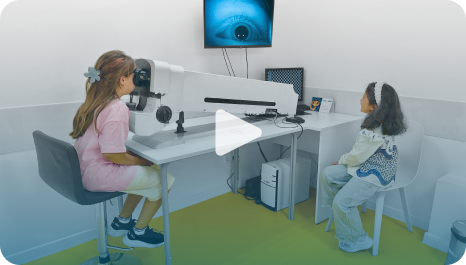
This is our own development and has been a genuine breakthrough in ophthalmology at a global level. Using BOK-1 we have been successfully treating amblyopia for over 7 years, even in the most complex cases where as little as 1–2% of vision remains.
- Effectiveness is four times higher compared to traditional methods.
- Age is no barrier: BOK-1 can help even adult patients.
STRABO oscillating glasses

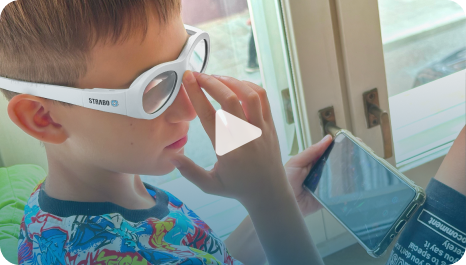
STRABO oscillating glasses represent a modern, high-technology approach to the treatment of "lazy eye," enabling effective training in the familiar home environment.
The glasses are individually programmed by the doctor for each child. Specialist liquid crystal lenses alternately darken and clear at set intervals, creating optimal conditions for engaging the amblyopic eye in active work.
This stimulates the brain to make greater use of the "lazy" eye, gradually restoring its function.
- Treatment can be combined with everyday activities (study, play, watching television)
- Individualised rehabilitation programmes for each patient
- No discomfort or skin irritation, unlike traditional occluders
- Modern ergonomic design that children enjoy
- Require no dedicated training time
This modern approach makes the treatment process comfortable for the child and allows maximum results to be achieved in restoring visual function.
Surgical treatment
Laser correction for amblyopia is indicated in cases of anisometropia. Surgery does not eliminate amblyopia itself, but removes the optical cause of its development. This subsequently enables conservative treatment to be carried out to treat the condition itself.Complications of amblyopia
Delayed or irregular treatment may cause complications of amblyopia. The most serious of these is irreversible deterioration of vision. This condition will require lifelong correction with glasses or contact lenses, without any improvement in visual acuity with glasses. Furthermore, in amblyopia the person ceases to perceive the world in three dimensions. Everything around them becomes flat, like a drawing on a sheet of paper. In children this may cause problems with judging distances and spatial orientation, leading to poor academic performance, limitations in active play, and ultimately social withdrawal and difficulties with socialisation.
Early diagnosis is the key to successful treatment of amblyopia. Remember: up to the age of 7, the child's visual system is at its most adaptable and responds well to correction.
Do not delay visiting a paediatric ophthalmologist! Choose your nearest Crystal Vision clinic and book an appointment with a specialist.