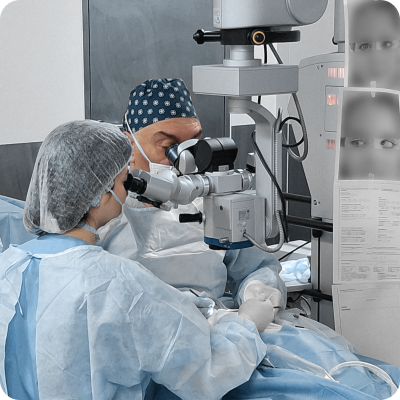
In 85% of strabismus cases, a surgical stage is required as part of comprehensive rehabilitation.
Childhood strabismus is not merely a cosmetic problem. The absence of symmetrical eye alignment leads to profound functional disorders of the visual system. Moreover, strabismus may not be a primary condition but rather a consequence of another, sometimes very serious, disease of the visual organ.
90% of children with strabismus cannot perceive 3D content.
This level of patient recovery is attributable to the use of innovative, high-technology diagnostic and treatment methods, many of which are our own proprietary developments, implemented and successfully applied for over 10 years.
These technologies attract consistent interest from our international colleagues, deliver very high effectiveness, and have helped us maintain a leading position in paediatric ophthalmology for over 25 years.
 Experienced surgeons
 State-of-the-art pre-operative diagnostics
 Innovative STRABO Care System for strabismus treatment and diagnostics
 Internationally certified clinic
 Minimally traumatic procedures
 High-frequency radio wave surgery
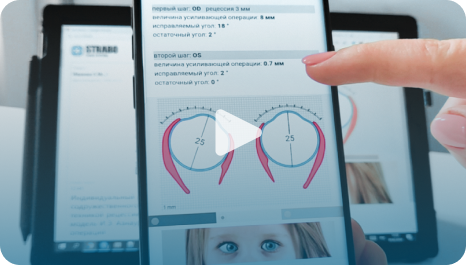
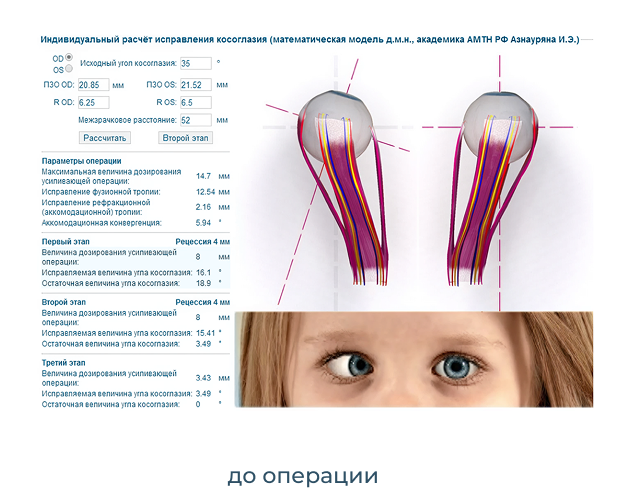
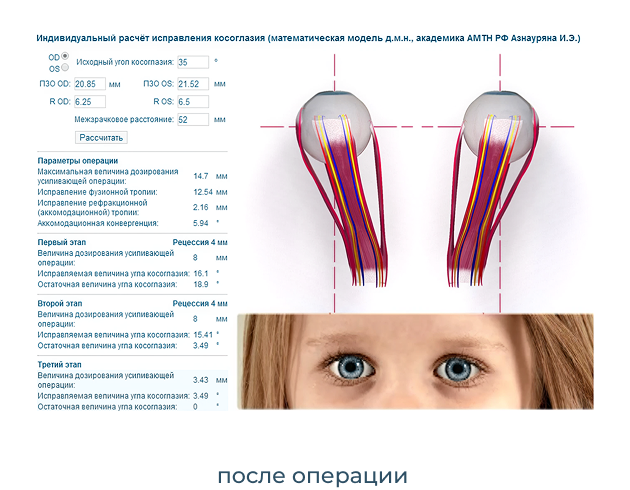
 STRABO soft mathematical surgical modelling for strabismus and nystagmus
 Reduced recovery times

Using this programme allows us not only to calculate the precise scope of surgery but also to minimise the number of operations required. And the planned outcome can be shown to parents before the procedure takes place.
Alongside STRABO technology, we use high-frequency radio wave surgery for strabismus.
This is the most advanced, safe, and precise technology in the world for the surgical treatment of oculomotor disorders, and has been recognised by our colleagues — paediatric eye surgeons — internationally.
We have moved away from traditional scalpels and scissors in favour of radio wave technology. We do not cut or suture; we preserve the structures of the eye.
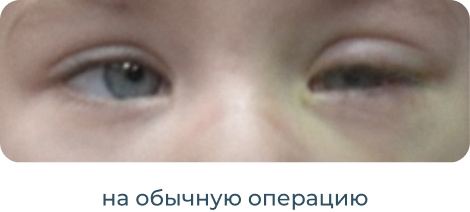
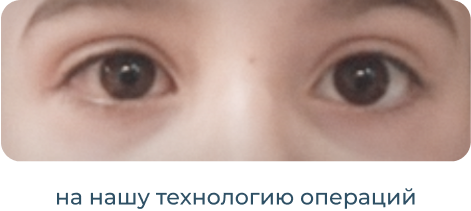
We are proud that the surgical strabismus treatment system we have developed — based on minimal invasiveness combined with mathematical modelling and radio wave surgery — has gained recognition not only among our many patients but also within the professional community, in Russia and abroad.
We aspire to make this innovative surgery available in time to everyone who needs it. Regrettably, all advanced technologies carry higher costs than conventional surgery. But we very much want every child and adult facing this serious systemic condition to have access to these latest techniques, regardless of their family's circumstances or income.
It is for this reason that we developed a technology which allows the cost of surgery to be significantly reduced without any serious compromise to precision. This more affordable approach closely mirrors the premium version in its principles. It incorporates elements of the conventional, widely used technique — but only those elements that are fully consistent with our effective methodology.
The Head of our Sokol clinic, Dr Magomed Isaevich Uzuev, a pupil of our clinic's founder Igor Erikovich Aznauryan, performs operations using microsurgical scissors, equally with the mandatory application of the mathematical modelling and surgical calculation method we developed — to ensure maximum precision. This approach is applicable to the dosing and performance of surgery for convergent strabismus only.
When patients come to us with strabismus, many cannot imagine that there are over 20 types of the condition. Among them is a particular form — paralytic strabismus. It is relatively rare, and not treated everywhere. In paralytic strabismus, eye movement is restricted in one or more directions of gaze. Three nerves are responsible for the contraction of the extraocular muscles, and dysfunction of any one of them leads to restricted ocular motility and the development of paralytic strabismus.
The most severe form of this condition is paresis (paralysis) of the oculomotor nerve. With oculomotor nerve paresis, it is impossible to direct the affected eye towards the fixation target. This leads to serious underdevelopment of the visual system.
Can we treat paresis? Yes, we can! We even restore ocular motility — something many sceptics consider impossible.
According to statistics, one in every 403 children is born with congenital strabismus. What does this mean? It means that this child's eyes are deprived from the outset of the opportunity to develop correctly, and surgery to correct the strabismus must be performed before the age of 3–4 years. It is up to this age that the visual system undergoes its final formation, and it is important to intervene now, while the child's eyes are still developing.
The aim of strabismus surgery is to position the eyeballs correctly so as to enable the subsequent development of binocular (two-eyed) and stereoscopic (three-dimensional) vision.
One experimental surgical approach involves injections of botulinum toxin into the extraocular muscles. This method is used in both adults and children.
The mechanism of this approach is that the muscle is temporarily inactivated by the injection and ceases to "pull" the eye towards it.
The reduction in the angle of strabismus achieved by such injections is temporary, and the angle will return to its original state once the effect of the drug wears off (after 3 to 6 months).