Did you know that seeing the world around you clearly — without fear or discomfort — is a real possibility with laser vision correction? At Crystal Vision clinics, we offer this opportunity not only to children but to adults as well!
Forget about glasses and lenses — start seeing the world in all its clarity. You can choose whether to have the correction fully conscious or under a specially administered, safe general anaesthetic that lasts just 10–15 minutes, whichever feels more comfortable for you.
At Crystal Vision clinics, we perform laser vision correction methods that have proven their high effectiveness and safety:
We use only the most advanced equipment and innovative, safe technologies.
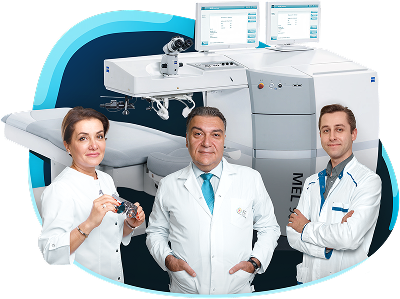
Procedures are performed on the MEL® 90 excimer laser by Zeiss — the world's most advanced refractive laser from the global leader in ophthalmology and microsurgery technology, German company Carl Zeiss Meditec AG. The Mercedes of the laser vision correction market!
Crystal Vision clinics were the first in Russia to introduce laser correction under general anaesthesia, and have successfully performed such procedures in both adults and children for many years. Our patients FALL ASLEEP, WAKE UP, AND CAN SEE.
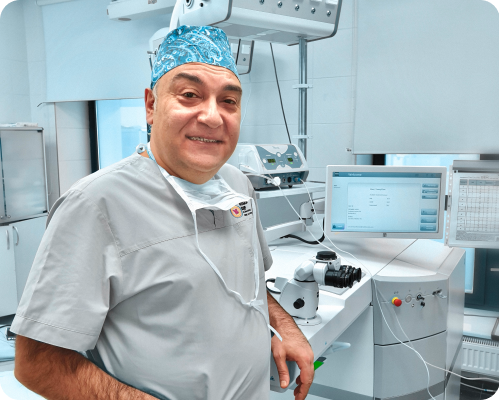
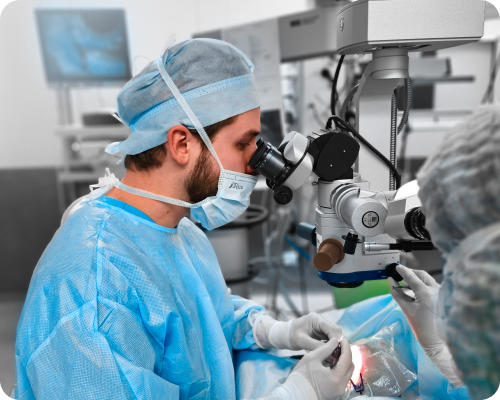
Our surgeons are among the most experienced in the field. At your choice, laser correction can be performed by a Candidate or Doctor of Medical Sciences. Our specialists have trained in Germany and are among the first certified specialists in Russia for the latest-generation MEL90 laser.
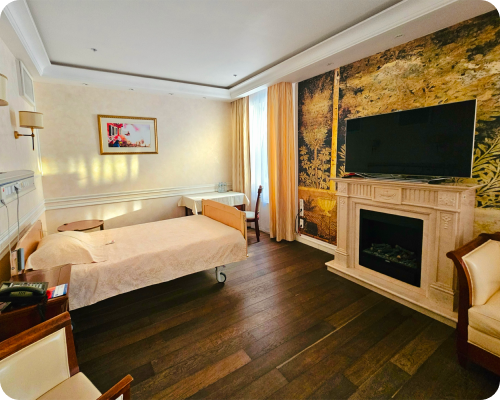
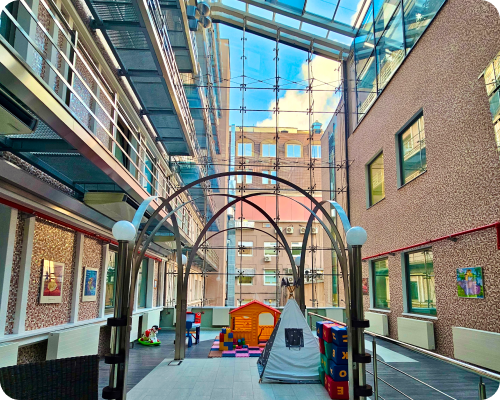
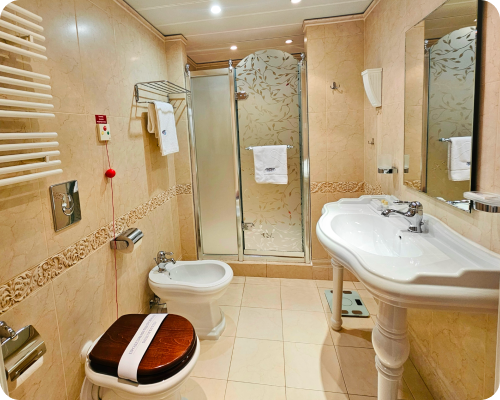
Laser vision correction procedures are performed in one of the finest inpatient facilities in Russia at the same price as standard laser correction. Patients rest before and after the procedure in five-star hotel-standard rooms.
IMPORTANT! We plan the procedure down to the finest detail. What does this mean in practice? Prior to laser correction, we carry out an extensive examination, meticulously and thoroughly assessing the patient's vision. Individual corneal characteristics (curvature, refraction) are taken into account when selecting the surgical technique. Our thorough diagnostics and individualised surgical planning allow excellent, stable vision to be achieved after correction and any complications to be avoided.
Types of laser correction
At Crystal Vision clinics, we perform laser vision correction methods that have proven their high effectiveness and safety:
LASIK
SUPER LASIK
PRK
Vision correction is performed using the Zeiss MEL 90 excimer refractive laser in an inpatient setting with the option of general anaesthesia. The choice of the optimal method for your vision is always made by the ophthalmic surgeon, based on examination data and individual characteristics of the condition.
PRK — photorefractive keratectomy
This is a surface ablation vision correction technology and the world's first excimer laser vision correction technology. The key feature that distinguishes it from more modern methods (e.g., LASIK) is the absence of a surgical incision and creation of a corneal flap. This is why PRK is called a "surface" or "flapless" technique. It is a time-tested, reliable and, most importantly, minimally traumatic for the deep corneal structures technology. Despite a more complex recovery period, it remains the "gold standard" for patients with thin corneas. However, the decision on the choice of correction method should always be made by an ophthalmologist after a full and thorough diagnostic examination.
How is PRK surgery performed?
Epithelium removal. Instead of cutting and folding a flap, the surgeon completely removes the top layer of the cornea — the epithelium. This can be done mechanically (using a special instrument — a scrubber), chemically with a solution that weakens the connection between the epithelium and underlying layers, or with a laser (in modifications of the method, e.g., TransPRK).
Laser treatment
After removal of the epithelium, the Bowman's membrane and corneal stroma are exposed. An excimer laser is directed onto this surface, which "vaporises" a thin layer of tissue according to a programmed pattern, changing the curvature of the cornea and eliminating refractive errors (myopia, hyperopia, astigmatism).
Protective lens placement
Since the epithelium has been removed, a medication and a soft contact lens are placed on the operated cornea. It acts as a "biological bandage", protecting the eye and reducing pain while new epithelium grows (typically in 3-5 days). The patient returns home in this condition. However, the recovery period after such correction is accompanied by pain, increased tearing, and photophobia.
Advantages of PRK or why the method is still chosen?
Despite a longer and more uncomfortable recovery period, PRK has several undeniable advantages that make it the method of choice in complex cases.
No risks associated with a flap. This is the main advantage. There is no risk of flap displacement, wrinkling, damage, or complications during its formation. This is critical for people with thin corneas, as well as for those whose profession or hobby involves a risk of eye injury (military personnel, athletes, boxers).
Ability to perform on thin corneas. Since the laser works on the surface, PRK allows correction for patients for whom LASIK or Femto-LASIK is contraindicated due to insufficient corneal thickness.
Minimal impact on corneal biomechanics. Since the integrity of the deep stromal layers is not compromised, corneal strength is better preserved than after LASIK.
Low risk of "dry eye" syndrome. Although dryness may be pronounced in the first months, the long-term risk of developing persistent dry eye syndrome after PRK is lower than after flap techniques, as the nerve fibres in the deeper layers of the cornea are not severed.
Recovery after PRK laser vision correction
PRK is not a universal procedure suitable for everyone. It has recovery characteristics. Long and painful post-operative period compared to other methods. The first 2-4 days after surgery, while the epithelium is healing, the patient may experience significant discomfort, pain, photophobia, and a feeling of "sand" in the eyes. This is the most difficult stage. Vision recovers gradually. In the first days after correction it will be hazy, and only after 1-2 weeks will it become stable. Maximum visual acuity may be achieved after several weeks or even months.
Indications: who is PRK suitable for?
PRK is not the first-choice procedure for everyone, but in certain situations it has no alternative:
Thin cornea
High degrees of myopia, hyperopia or astigmatism where corneal thickness is insufficient for LASIK
Professions involving a risk of eye injury
Corneal surface abnormalities
Early stages of keratoconus (in combination with cross-linking)
LASIK — flap-based vision correction technology
This is the most popular and widespread method of excimer laser correction, also known as "flap" technology. Its key feature is the creation of a thin flap from the surface layer of the cornea, allowing access to the middle layers for laser shaping of new corneal curvature. The main difference from the PRK method is the preservation of the epithelium.
How is LASIK surgery performed?
Flap formation — the most critical stage of the operation. Using a special automatic instrument with a fine blade (microkeratome), a flap 90 microns thick is created on the surface of the cornea. The flap is not cut completely, but remains attached on one side, forming a kind of "hinge". The surgeon then carefully folds the created flap to the side, exposing the middle layer of the cornea (stroma). The laser then performs dioptre modelling according to a programmed pattern. The excimer laser is directed onto the exposed stroma, vaporising part of the tissue according to a pre-calculated programme, changing the curvature of the cornea and eliminating vision defects: myopia, hyperopia, astigmatism. After completion of the laser treatment, the surgeon returns the corneal flap to its original position. Due to the inherent adhesive properties of the cornea, the flap securely attaches without sutures, acting as a natural biological bandage.
Key advantages of LASIK
Rapid vision recovery
Vision begins to improve literally 1-2 hours after correction. By the end of the first day, most patients see quite well, and by the next morning, vision generally reaches the planned values.
Minimal discomfort
The procedure is painless and takes no more than 1 hour. In the first hours after laser correction, minor unpleasant sensations are possible: lacrimation, sensation of a foreign body, photophobia.
Short recovery period
The patient can return to work and normal life within 1-2 days after correction.
Indications and who is LASIK suitable for?
The LASIK method is suitable for most patients under the following conditions:
Stable vision for the past year
Absence of contraindications: autoimmune diseases, severe diabetes, cataracts, glaucoma, keratoconus, pregnancy and breastfeeding
Sufficient corneal thickness
Moderate degrees of refractive errors (myopia, hyperopia, astigmatism)
The choice of vision correction method always remains with the attending physician after a thorough diagnosis.
SUPER LASIK or Femto LASIK
This is not a separate type of operation, but an improved version of the LASIK method in which two lasers work. One femtosecond laser removes the surface layer of the cornea, while the excimer laser works according to a programme to remove dioptres and correct vision. The conventional LASIK method corrects only two basic refractive errors: myopia, hyperopia with astigmatism. The laser works according to standard algorithms, "smoothing" the cornea to set parameters. SUPER LASIK corrects not only these basic anomalies, but also all kinds of higher-order aberrations.
This vision correction method is a customised technique and requires a more thorough examination to determine precise individual parameters. Therefore, detailed diagnostics (corneal topography) are necessary before the operation. It creates a unique "optical map" or "passport" of the eye, determining with micron accuracy all existing distortions, including higher-order aberrations.
Laser vision correction during pregnancy planning and during pregnancy
Laser correction at the stage of pregnancy planning is allowed. Ophthalmologists advise having the procedure at least 3 months before the intended conception. If a woman is not sure whether she is pregnant or not, then before laser correction she needs to take a blood test for hCG – this test will reliably show whether pregnancy is present.
Используя наш сайт, вы предоставляете согласие на обработку файлов Cookie и других персональных данных в соответствии с Федеральным Законом РФ 30.11.2024 N 420-ФЗ.