


Myopia
Fact! Medical examination statistics show that symptoms of myopia are observed in 70% of senior school pupils in Russia.
It is critically important to know that childhood myopia must be treated — otherwise the condition can lead to complications and more serious pathologies of the visual system, including amblyopia and other eye diseases.
At Crystal Vision clinics, we have been carefully helping children preserve and improve their vision in myopia for over 25 years, using unique methods.
Moreover, our knowledge, technologies and experience can enable a child to give up glasses permanently!
The most important thing is not to lose time — act at the first signs of a problem!
Causes of myopia in children
Myopia in children typically develops due to three factors: heredity (if parents have vision problems, the risk increases), visual overload (prolonged use of digital devices and academic demands), and insufficient natural light (the child spending too much time indoors).
Poor visual habits (inadequate lighting at the study desk and incorrect posture) and the child's general state of health also play an important role. Timely diagnostics and adherence to the doctor's recommendations will help preserve your child's vision and prevent myopia from progressing.
At Crystal Vision clinics, we offer an individualised approach to each patient and modern methods of myopia correction in children.
Types and degrees of myopia in children
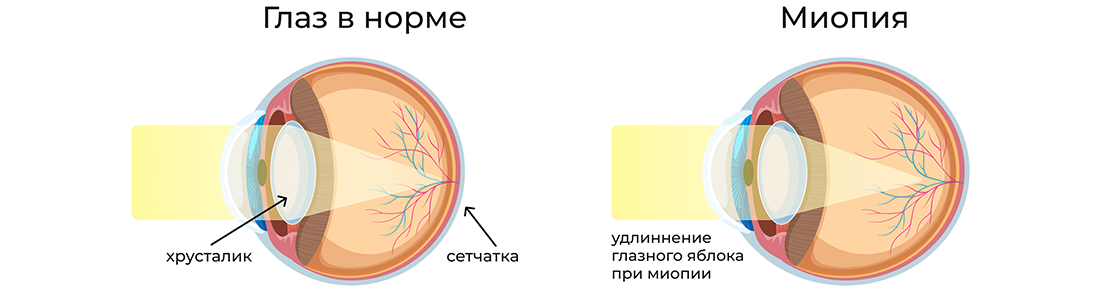
The type and stage of myopia, and the treatment methods prescribed, depend on the extent to which the retina can refract light — the primary factor determining the overall development of myopia. This, like the stages of the condition, is measured in dioptres. Three stages of myopia are identified:
- Mild myopia — up to 3 dioptres
- Moderate myopia — from 3 to 6 dioptres
- High myopia — from 6 to 15–30 dioptres
The treatment approach is selected depending on whether the myopia is congenital or acquired. Congenital myopia has complex causes — this form of the condition is frequently associated with dysfunctions and pathologies of intrauterine foetal development.
Acquired myopia has external causes and is being identified increasingly often in urban children. It is typically detected when a pre-school child undergoes a medical examination in preparation for starting school.
The most dangerous form is progressive myopia, which without appropriate treatment can lead to complete blindness through retinal detachment.
Symptoms of myopia
In young pre-school and school-age children, symptoms of myopia include:
- Poor posture
- Frequent squinting when looking at distant objects
- Frequent headaches
- Increased fatigue
- Dryness and eye pain
- Complaints that the child cannot see what the teacher writes on the board
Diagnostics
For effective treatment of myopia in children, it must be identified promptly and accurately. Modern diagnostic methods are used to establish the diagnosis:
Types of diagnostics
-
Goldman lens examination
Performed for detailed examination of the retina and internal ocular structures. -
Ultrasound A-scan
Performed to assess the axial length of the eyeball and monitor its growth over time. -
Computerised perimetry
A precise method for examining the visual field and determining retinal light sensitivity.
-
Optical coherence tomography (OCT)
A high-technology, non-invasive examination to exclude occult lesions of the retina and optic nerve. -
Electrophysiological examination (EPR)
A method for detecting amblyopia and optic nerve atrophy, and for evaluating treatment progress.
All diagnostic examinations are non-invasive, brief, and entirely painless.
Treatment of myopia in children
Regular, correctly selected therapy for these eye conditions halts disease progression in 85-90% of cases. When a child's visual acuity deteriorates at a rate of 0.5 dioptres per year, the doctor prescribes optical correction to prevent further progression — recommending glasses or contact lenses of the appropriate dioptric power.
Contact lenses may only be worn after the condition has stabilised, and must be selected with care, with precise verification of the dioptric power.
Hardware-based treatment methods used include specialist medical devices for:
- Photomagnetic stimulation
- Magnetic therapy
- Laser stimulation
- Electrical stimulation
Conservative treatment of myopia follows this sequence:
Comprehensive treatment with individually tailored therapy programmes based on examination findings.
Ophthalmology has made enormous advances, and the world's leading clinics now perform laser correction of myopia not only in adults but also in children. We are proud that Crystal Vision was one of the very first eye clinics to implement this technology, and we have extensive and successful experience in this area.
Light is then correctly focused on the retina and vision is normalised.
Prevention of myopia
Doctors recommend that all parents take preventive measures against myopia in their children. Preventive measures help maintain the results achieved through treatment and support the restoration of visual function in children. It is important not only to begin treatment promptly when myopia is present, but to carry out regular prevention — both for children who have already been diagnosed and for those who have not yet been.
To this end, parents should:
- Ensure correct lighting above the child's study desk
- Not allow children to read or use a smartphone or computer in the dark
- Monitor the time children spend watching television or using a computer screen
- Maintain a regular routine, taking the child outdoors for at least 1-2 hours every day
- Pay attention to the child's physical development
Adhering to these preventive measures in the context of the growing demands placed on young eyes will help prevent the development of myopia in school-age children.