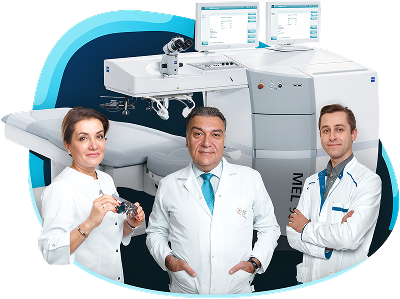
Did you know that seeing the world around you clearly — without fear or discomfort — is a real possibility with laser vision correction? At Crystal Vision clinics, we offer this opportunity not only to children but to adults as well!
Forget about glasses and lenses — start seeing the world in all its clarity. You can choose whether to have the correction fully conscious or under a specially administered, safe general anaesthetic that lasts just 10–15 minutes, whichever feels more comfortable for you.
At Crystal Vision clinics, we perform laser vision correction methods that have proven their high effectiveness and safety.
We use only the most advanced equipment and innovative, safe technologies.
Procedures are performed on the MEL® 90 excimer laser by Zeiss — the world's most advanced refractive laser from the global leader in ophthalmology and microsurgery technology, German company Carl Zeiss Meditec AG. The Rolls-Royce of the laser vision correction market!
Crystal Vision clinics were the first in Russia to introduce laser correction under general anaesthesia, and have successfully performed such procedures in both adults and children for many years. Our patients FALL ASLEEP, WAKE UP, AND CAN SEE.
Our surgeons are among the most experienced in the field. At your choice, laser correction can be performed by a Candidate or Doctor of Medical Sciences. Our specialists have trained in Germany and are among the first certified specialists in Russia for the latest-generation MEL90 laser.
Laser vision correction procedures are performed in one of the finest inpatient facilities in Russia at the same price as standard laser correction. Patients rest before and after the procedure in five-star hotel-standard rooms.
IMPORTANT! We plan the procedure down to the finest detail. Prior to laser correction, we carry out an extensive examination, meticulously and thoroughly assessing the patient's vision. Individual corneal characteristics (curvature, refraction) are taken into account when selecting the surgical technique. Our thorough diagnostics and individualised surgical planning allow excellent, stable vision to be achieved after correction and any complications to be avoided.
PRK — Photorefractive Keratectomy
At Crystal Vision clinics, we perform laser vision correction methods that have proven their high effectiveness and safety. Correction is performed using the ZEISS MEL 90 refractive excimer laser, in an inpatient setting with the option of general anaesthesia. The optimal method for your vision is always selected by the ophthalmic surgeon based on examination findings and the individual characteristics of your condition.
PRK is a flapless vision correction technology and the world's first excimer laser vision correction technique. Its key distinguishing feature compared to more modern methods (such as LASIK) is the absence of a surgical incision and the creation of a corneal flap. This is why PRK is called a "surface" or "flapless" technique. It is a time-proven, reliable, and — most importantly — minimally traumatic technology for the deep corneal structures. Despite a more involved recovery period, it remains the "gold standard" for patients with thin corneas. However, the choice of correction method should always be made by the ophthalmologist following a full and thorough diagnostic examination.
How is a PRK procedure performed?
Epithelial removal. Rather than cutting and folding back a flap, the surgeon completely removes the outermost layer of the cornea — the epithelium. This can be done mechanically (using a specialised instrument — an epithelial scraper), chemically using a solution that weakens the bond between the epithelium and the underlying layers, or with a laser (in method modifications such as TransPRK).
Laser treatment
Once the epithelium has been removed, Bowman's membrane and the corneal stroma are exposed. The excimer laser is directed onto this surface and, following a programmed protocol, "ablates" an extremely thin layer of tissue, reshaping the corneal curvature and correcting refractive errors (myopia, hyperopia, astigmatism).
Application of a protective lens
Since the epithelium has been removed, a medication is applied to the treated cornea along with a soft contact lens. This acts as a "biological bandage," protecting the eye and reducing discomfort while the new epithelium regenerates — a process that typically takes 3–5 days. The patient returns home in this condition. The recovery period may involve pain, increased lacrimation, and photophobia.
Advantages of PRK — why is it still chosen?
Despite a longer and more uncomfortable recovery, PRK has a number of undeniable advantages that make it the preferred choice in complex situations.
No flap-related risks. This is its primary advantage. There is no risk of flap displacement, wrinkling, damage, or complications during flap creation. This is critically important for people with thin corneas and for those whose profession or hobbies involve a risk of eye injury (military personnel, athletes, boxers).
Suitability for thin corneas. Since the laser works on the corneal surface, PRK allows correction for patients for whom LASIK or Femto-LASIK is contraindicated due to insufficient corneal thickness.
Minimal impact on corneal biomechanics. Since the integrity of the deep stromal layers is not compromised, corneal strength is better preserved than after LASIK.
Lower long-term risk of dry eye syndrome. Although dryness may be pronounced in the first months, the long-term risk of developing persistent dry eye syndrome after PRK is lower than after flap-based methods, as the nerve fibres deep within the cornea are not severed.
Recovery after PRK
PRK is not a universal procedure suitable for everyone and has its own recovery profile. The post-operative period is longer and more uncomfortable than with other methods. For the first 2–4 days after surgery, while the epithelium heals, the patient may experience significant discomfort, pain, photophobia, and a "gritty" sensation in the eyes — the most challenging phase. Vision recovers gradually: it will be hazy in the first days and only stabilises after 1–2 weeks. Maximum visual acuity may be reached over a period of several weeks or even months.
Indications: who is PRK suitable for?
PRK is not the first-choice procedure for everyone, but in certain situations it has no alternative:
Thin corneas
High degrees of myopia, hyperopia, or astigmatism where corneal thickness is insufficient for LASIK
Early-stage keratoconus (combined with cross-linking)
Laser vision correction when planning pregnancy and during pregnancy
Laser correction can be performed during the pre-pregnancy planning stage. Ophthalmologists recommend having the procedure at least 3 months before the planned date of conception. If a woman is unsure whether she is pregnant, a blood test for hCG — which will definitively establish the presence of pregnancy — must be taken before undergoing laser correction.
Используя наш сайт, вы предоставляете согласие на обработку файлов Cookie и других персональных данных в соответствии с Федеральным Законом РФ 30.11.2024 N 420-ФЗ.