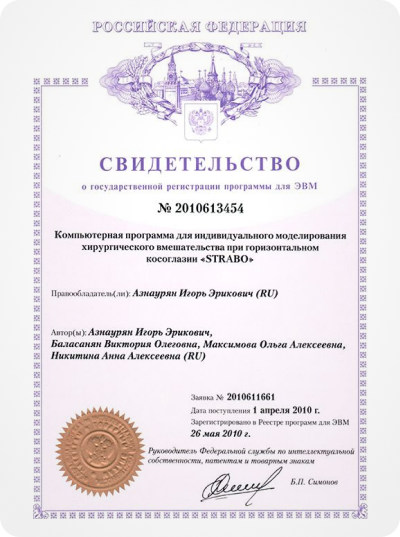
STRABO surgical modelling for strabismus
The goal of the STRABO programme was to develop a unique method for treating strabismus that would be in demand not only in Russia but beyond its borders. The complexity of surgery on the extraocular muscles and the predictability of outcomes are the principal factors that determined the need to create a mathematical modelling system for calculating strabismus surgery.
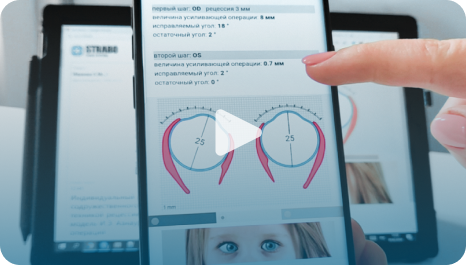
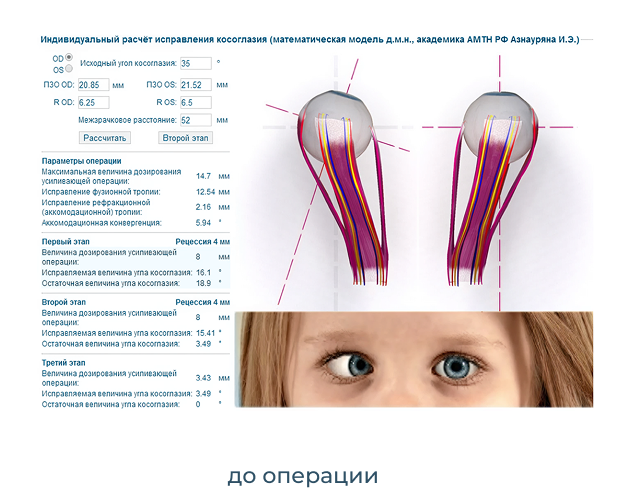
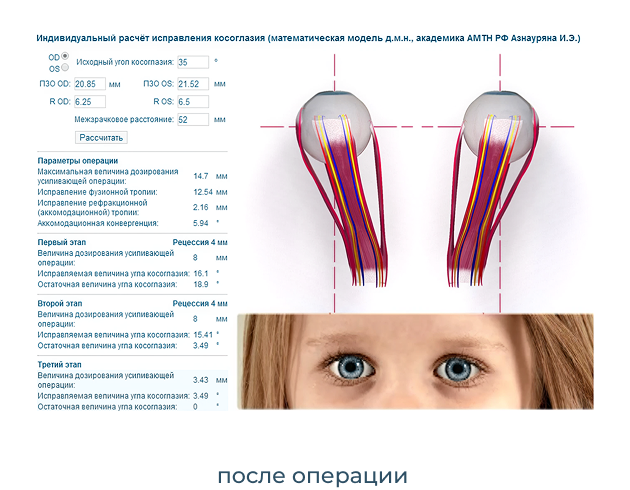
It was for this reason that the STRABO programme was created — enabling individualised calculation of each stage of the operation and restoration of symmetrical eye alignment.
Advantages of surgical treatment using the STRABO care system
Standard technology
Innovative STRABO care system

Pre-operative assessment and diagnostics
Only the individual parameters of the angle of strabismus are taken into account.
We take into account the individual parameters of the angle of strabismus, the structure of the eyeball and muscles using the Gazelab video-oculograph. We also use the STRABO soft mathematical surgical model, which allows the planned outcome to be shown to parents before the operation takes place.
Surgery
Surgical dosing data are provided, which may be adjusted at the discretion of each surgeon based on their experience.
STRABO soft provides individualised surgical dosing data, calculating each stage of the procedure.
Rehabilitation
Post-operative recovery takes approximately one month.
We use a radio wave instrument that does not cut but vaporises tissue, reducing surgical trauma to virtually zero and cutting recovery time fourfold.
Outcome
Undercorrection (incomplete elimination of the angle of strabismus) and overcorrection (secondary reverse divergent strabismus).
The use of STRABO soft allows us to predict outcomes and achieve high precision — to within 5 degrees. These are the highest precision figures in current global practice.
With conventional surgical methods there is a significant margin of error and a risk of post-operative complications, resulting in less than fully symmetrical eye alignment. Imprecision in strabismus surgery can lead to incomplete correction of the angle of deviation or even a hypereffect — that is, secondary reverse strabismus. Such imprecision can cause not only cosmetic problems but also difficulties in restoring three-dimensional vision.
The STRABO programme, by contrast, makes it possible to avoid these problems and achieve the desired outcome without risk to the patient's health.
Strabismus surgery

Modern ophthalmology employs the latest advances to ensure the most effective treatment of strabismus in children. One such advance is the mathematical modelling of strabismus correction surgery, which we have named "STRABO".
Using this technology, we calculate every step of the operation with precision, taking into account the individual parameters of each child — including the angle of strabismus, visual acuity, whether the patient wears glasses and of what type, and so forth. The result is symmetrical eye alignment. The success rate of this procedure is over 98%!
STRABO mathematical modelling thus represents an important innovative step forward in the modern treatment of strabismus in children, delivering maximum and lasting results.
The system models the entire course of the operation, and it is even possible to show parents the planned surgical outcome before the procedure takes place.
Individualised mathematical modelling also helps reduce the number of planned surgical stages.
Nystagmus surgery
Today, the treatment of nystagmus employs advanced, high-precision and safe techniques, including STRABO mathematical modelling and high-frequency radio wave surgery.
These methods address various forms of nystagmus by reducing oscillatory eye movements when looking straight ahead.
Surgery based on these technologies does not involve scalpels or scissors, which promotes faster patient recovery, while mathematical modelling ensures the highest precision in surgical calculations.
New surgical treatment methods for nystagmus include unique approaches determined individually for each patient, taking into account the type and cause of their condition. They aim to reduce eye oscillations, correct abnormal head posture, and restore visual function.
In 75% of cases, nystagmus blocking is achieved in a single operation!
-
Ten years ago, STRABO technology was first presented at international forums in the United States, Japan and Western Europe. A genuine breakthrough in ophthalmic surgery, it was immediately met with widespread recognition by many colleagues around the world.
Surgeons using the STRABO modelling programme