


Brown syndrome
A child cannot raise the eye upwards, and when looking to the side, the eyeball involuntarily moves down?
These symptoms may be a sign of a rare and complex form of strabismus – Brown syndrome. Most often, this condition has an anatomical origin. The difficulty in treating Brown syndrome lies in the fact that, in each individual case, it is necessary to choose personalised treatment methods, and they can differ greatly.
Unlike most other ophthalmology clinics, at Crystal Vision we use an individual and precise approach to treatment from the very first steps. As part of the diagnosis of Brown syndrome, we always use MRI, which allows our specialists to determine the most accurate tactics for further treatment of each patient in every specific case.
Why is accurate diagnosis 90% of success?
As you already know, the difficulty in treating Brown syndrome lies in the fact that its manifestations and anatomical causes are unique for each patient. There is no single technique or standard operation that can cure this condition. An incorrectly chosen treatment strategy may not only fail to help, but also cause harm. At the same time, many clinics limit themselves to a standard examination for diagnosis. In the case of Brown syndrome, this can lead to treatment errors and serious consequences.
In Crystal Vision clinics, only a modern and maximally precise approach is used for the diagnosis of Brown syndrome.
Our diagnostic methods:
- Extended ophthalmological examination with special tests for eye movements
- MRI of the orbits – the gold standard of diagnosis in our clinic to confirm and detail Brown syndrome
- Consultation with a paediatric ophthalmologist-strabismologist (strabismus specialist) with extensive experience in rare pathologies
Treatment and surgery
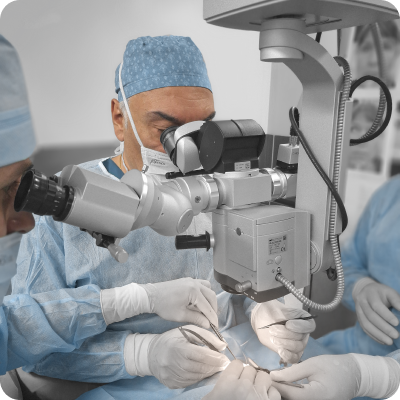
When treatment is necessary and, especially, when surgical correction of Brown syndrome is required, the surgeon's experience comes to the forefront. In this, Crystal Vision has a truly unique advantage. Thanks to the immense experience of Doctor of Medical Sciences, Professor, Head of the Crystal Vision clinic group – Professor Igor Aznauryan, who has performed over 35,000 successful surgeries, we are able to restore correct eye movements and healthy eye position even in the most complex cases.
Answers to common questions from parents
Is Brown syndrome hereditary?
In most cases, it is a congenital anatomical feature that is not related to heredity.
Is MRI dangerous for a child?
It is absolutely safe. MRI is not an X-ray; it does not use ionizing (that very dangerous) radiation. If necessary, and if the child is anxious, the examination can be performed under special medication-induced sleep for children, under the supervision of an experienced paediatric anaesthesiologist.
Is it possible to do without surgery?
Only a doctor can decide this after a full diagnostic work-up. If eye mobility is significantly limited and there is a risk of amblyopia developing, or if a cosmetic defect affects the child's socialisation, surgery will be recommended as the only effective method.
At what age is it best to operate in Brown syndrome?
The optimal age is determined individually, but most often surgery is performed in the preschool period (3–5 years), so that by school age the child has formed correct binocular (three-dimensional) vision.
 Do not put off solving the problem. Early and accurate diagnosis is the key to successful treatment and a happy future for your child.
Diagnosis and surgical modelling for nystagmus