


Nystagmus
Nystagmus is not simply involuntary eye movements — it is a complex condition in which the eyeballs make uncontrolled movements (horizontal, vertical, or rotatory).
The person cannot control or stop them. The problem affects not only appearance but frequently leads to a significant reduction in visual acuity and makes fixation of gaze difficult.
At Crystal Vision clinics, under the leadership of Professor Igor Erikovich Aznauryan, a fundamentally new and highly effective approach to the treatment of nystagmus has been developed.
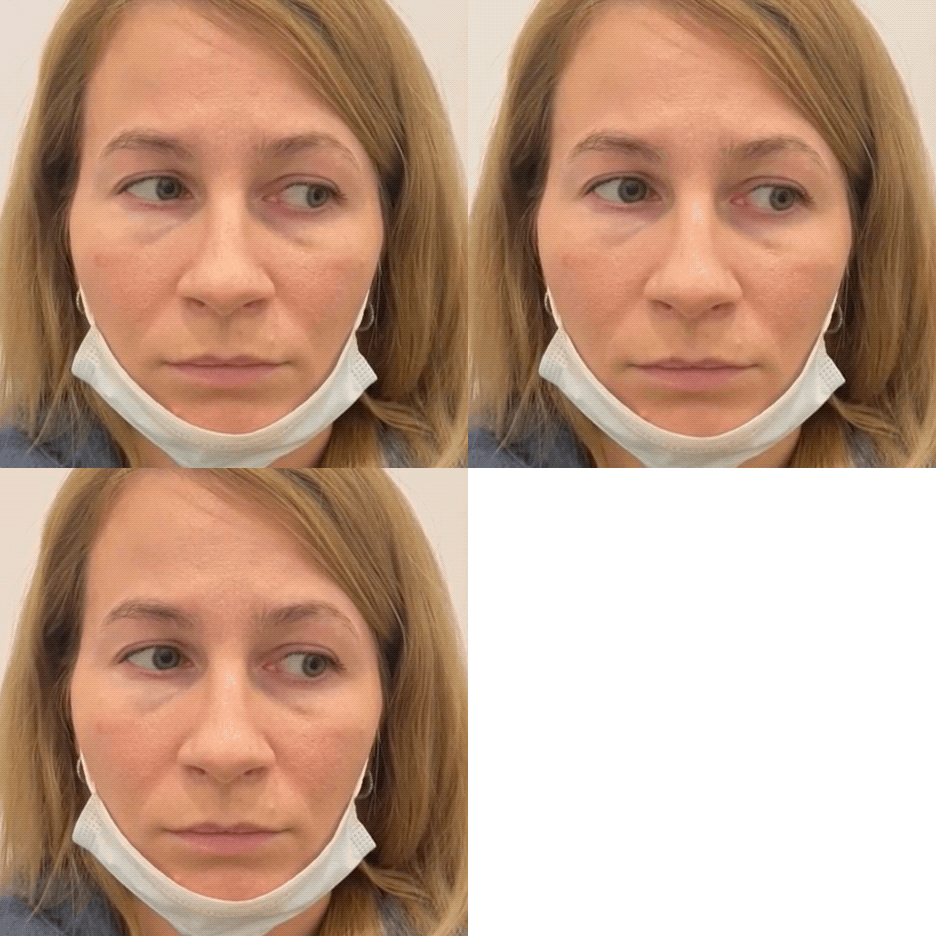
Contrary to the widespread belief that nystagmus is untreatable, our clinical experience proves otherwise:
- In 78% of cases we completely eliminate pathological eye movements in the straight-ahead direction of gaze; in the remaining 22% of cases we significantly reduce them
- We apply individualised therapeutic programmes to improve visual acuity
- We achieve stable, lasting results
It is important to know, however, that the earlier comprehensive treatment begins, the better the outcome and visual acuity.
Treatment of nystagmus in children
Crystal Vision clinics use a comprehensive approach:
- Surgical treatment
- Optical correction (optics)
- Specialist therapeutic treatment
Crystal Vision's strabismus treatment outcomes are among the best in Russia and internationally!
This level of patient recovery is attributable to the use of innovative, high-technology diagnostic and treatment methods, many of which are our own proprietary developments, implemented and successfully applied for over 10 years.
These technologies attract consistent interest from our international colleagues, deliver very high effectiveness, and have helped us maintain a leading position in paediatric ophthalmology for over 25 years!
 Experienced surgeons
 State-of-the-art pre-operative diagnostics
 Innovative STRABO Care System for strabismus treatment and diagnostics
 Internationally certified clinic
 Minimally traumatic procedures
 High-frequency radio wave surgery
 STRABO soft mathematical surgical modelling for strabismus and nystagmus
 Reduced recovery times
Nystagmus diagnostics
Only an experienced, highly qualified ophthalmologist can identify the cause of nystagmus and select the optimal treatment approach.
Thorough diagnostics frequently reveal neurological and other underlying causes. If nystagmus is caused by a concurrent condition, we provide treatment in collaboration with leading specialists from other medical disciplines — neurologists, endocrinologists, and others.
Examinations that may be prescribed during diagnostics:
Crystal Vision uses the unique Gazelab diagnostic complex — the only such device in Russia and the CIS. It allows precise identification of the affected eye muscle in children from as young as 2 years, which directly informs the future surgical treatment strategy.
- Electrophysiological examinations
- Optical coherence tomography
- Genetic tests (to identify congenital origin)
- MRI, CT, EEG and echoencephalography (to exclude other neurological causes)
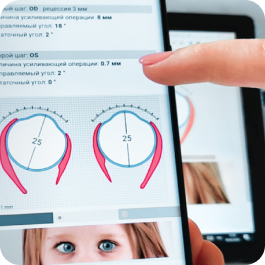
Diagnostics and surgical modelling for nystagmus

Treatment of nystagmus
At Crystal Vision, surgical treatment of nystagmus is performed using STRABO Care System technology, developed by Professor Igor Erikovich Aznauryan and a team of leading ophthalmologists from Russia and abroad.
The technology incorporates innovative radio wave surgery and mathematical modelling — without traditional scissors or scalpels — guaranteeing excellent results.
We apply four types of surgery depending on the form of nystagmus, always maintaining an individualised approach to each child. In some cases, laser vision correction is possible even in patients with nystagmus — thanks to innovative customisation technology and the eye-tracker function, performed under general anaesthesia.
This approach allows us to:
- Achieve full nystagmus compensation in 78% of patients and significant improvement in the remainder
- Substantially improve visual function and ensure a long-term, stable result
- Minimise tissue trauma, preserving vessels and nerves
- Reduce the rehabilitation period fivefold to sixfold — patients are discharged the day after surgery
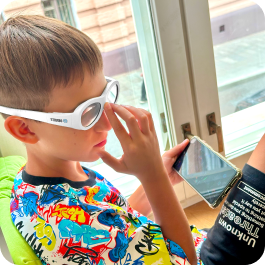
STRABO Care System: treatment of nystagmus, strabismus and amblyopia
Causes of nystagmus in children
Nystagmus may be caused by various disorders in central nervous system function. It may be congenital or acquired. The former refers to nystagmus in newborns. In acquired nystagmus, the clinical picture is frequently complicated by partial or complete optic nerve atrophy, refractive conditions (myopia, astigmatism), and is also found in children with genetic disorders (Leber's disease, albinism).
Causes of acquired nystagmus are similar in adults and children:
- Encephalitis
- Eye trauma
- Exposure to narcotic substances or toxins
- Brain conditions
- Head injury
- Inner ear inflammation
- Stroke
- Multiple sclerosis
- Ménière's disease
Particular features of nystagmus in children
A newborn over 3–4 weeks of age should begin to fix their gaze on objects. If fixation is absent and oscillatory movements are present, a specialist should be seen as soon as possible to identify the cause and begin treatment at the earliest opportunity.
If this does not happen, the child should be checked for congenital nystagmus. Children, particularly young ones, find it harder to report the discomfort caused by the condition. Recurrent dizziness, a sense of instability, and oscillation of visual images lead to a distorted perception of the surrounding world and deterioration of vision.
Symptoms of nystagmus
The child's head may frequently adopt an abnormal position — a condition known as ocular torticollis. This occurs because in nystagmus there is always a head position at which the oscillatory movements are significantly reduced or disappear entirely. The child unconsciously finds this position and begins to look from it, since the reduced oscillation results in better visual quality and acuity. It is difficult for a child of any age to identify the problem themselves, particularly since nystagmus often develops against the background of another condition.
Types of nystagmus
The condition is classified by various parameters. Nystagmus may be congenital (identified after birth) or acquired (manifesting at any age in the presence of nervous system dysfunction).
By clinical character, nystagmus is categorised as:
The latter condition also has 3 subtypes – vestibular, positioning, and optokinetic.
Vestibular nystagmus manifests as jerk-like movements and is found in people who have had an inner ear infection or Ménière's disease. Optokinetic nystagmus is characterised by saccadic eye movements. Positioning nystagmus is visible at extreme lateral gaze.
Classification of nystagmus by direction of oscillation
By the type of recurring eye movements, the condition is divided into horizontal, rotatory (rotational), diagonal, and vertical nystagmus. In the latter, the eyes move up and down — i.e. vertically. Diagonal nystagmus is identified when oscillations occur diagonally; rotatory nystagmus when the eye moves in a circular pattern. Oscillations are classified as jerk, pendular, or mixed.
In practice, horizontal nystagmus — in which eye movements are directed along the horizontal axis, i.e. left and right — is the most common form. Other forms occur less frequently. Nystagmus is also classified by amplitude as small-, medium-, or large-amplitude.