

Convergent strabismus in children
Convergent strabismus in children can appear at different ages.
• Congenital convergent strabismus appears before the age of one year. If it is acquired convergent strabismus, it will appear after 2–3 years of age. In congenital strabismus, surgical treatment will necessarily be the first step.
• Acquired strabismus is associated with optical problems in the child, the presence of amblyopia, or high hypermetropia (farsightedness).

What should you do if you suspect your baby has strabismus?
First, you need to see a paediatric ophthalmologist to perform a full examination of the oculomotor functions. This concerns not only eye movements; it is also necessary to examine the fundus of the eye. In mixed pathology, when combined with amblyopia or other disorders of visual function, in‑depth investigations are required, such as OCT, electrophysiological tests (EFI), and fundus examination with a Goldmann lens. Then, depending on the type of strabismus, a treatment strategy is developed.
Types of treatment for strabismus in children
Congenital convergent strabismus
Congenital convergent strabismus most often has very large angles. First of all, it is necessary to straighten the child's eyes so that vision can start to function better.
Acquired convergent strabismus
If the strabismus is acquired, then the treatment strategy depends on what type of strabismus it is. If strabismus is associated with optical defects, such as high hypermetropia, then in most such children it is first necessary to perform laser vision correction, which will straighten the eyes, and then monitor whether a surgical stage on the extraocular muscles is needed. Accommodative strabismus is often corrected only with the help of laser correction. If it is partially accommodative strabismus, laser vision correction must first be performed, and then, with the residual angle, surgery is planned and modelled.
 Divergent strabismus
The statistics for strabismus treatment at Crystal Vision clinics are among the best in Russia and abroad!
This high recovery rate in our patients is due to the use of innovative, high‑tech diagnostic and treatment methods, many of which are our own in‑house developments that we have introduced and successfully used for more than 10 years.
These technologies attract constant interest from our international colleagues and provide very high effectiveness, and for more than 25 years we have maintained a leading position in paediatric ophthalmology!
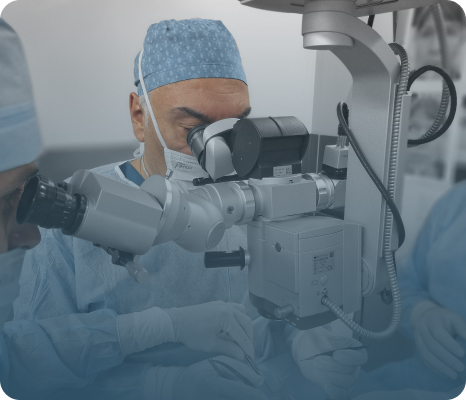
 Experienced surgeons
 Modern preoperative diagnostic methods
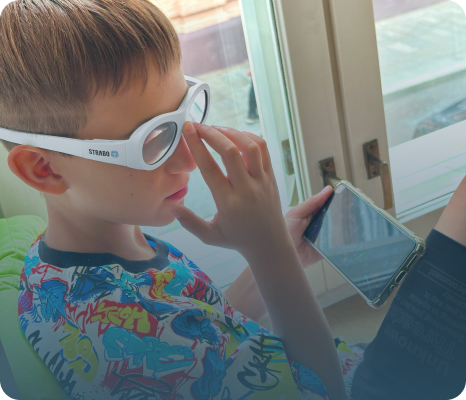
 Innovative STRABO Care System for strabismus treatment and diagnostics
 Internationally certified clinic
 Low‑trauma techniques
 High‑frequency radio wave surgery
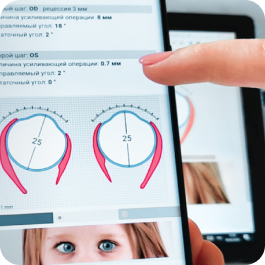
 Mathematical modelling of surgery for strabismus and nystagmus – STRABO soft
 Shortened recovery times
Diagnosis and surgical planning for nystagmus