


Assessment of binocular functions and cyclotropia
The human eyes perform a wide range of movements in different planes, the primary ones being horizontal and vertical.
These include movements to the right, left, upward and downward, as well as convergent and divergent movements of the visual axes, the purpose of which is to achieve binocular fusion of the images from both eyes. These movements can be performed within a defined range. In addition to horizontal and vertical movements, the eyes also perform movements in the frontal plane around the sagittal axis — both towards the nose and towards the temple.
These are known as torsional or rotary eye movements.
Deviations of the eyes in these directions are referred to as cyclodeviation or cyclotropia (incyclotropia or excyclotropia).
All of these eye movements are carried out by 6 pairs of muscles — 2 oblique and 4 rectus.
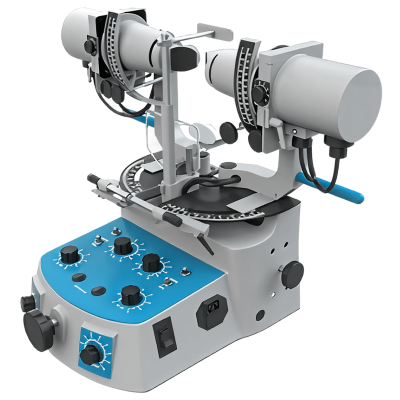
Any dysfunction of these muscles (palsies or pareses) can cause ocular deviation and lead to strabismus. To identify such conditions accurately, an assessment of binocular functions and cyclotropia is performed, allowing the clinician to evaluate the patient's treatment strategy and monitor progress appropriately.
- PediaVision: remote autorefractometer
- A-scan or echobiometry
- Autorefractometry
- Accommodometry
- Gazelab video-oculograph
- Assessment of binocular functions and cyclotropia
- Visual evoked potentials
- Depth perception assessment
- Stereoscopic vision assessment